Airbus A380
| Singapore Airlines 9V-SKA, the first A380 in commercial service | |
| Role | |
| Manufacturer | |
| First flight | |
| Introduced | |
| Primary users | |
| Produced | 2004 – present |
| Number built | 18 as of August 2008 |
| Unit cost | US$317.2-337.5 million |

INTRODUCTION:
The Airbus A380 is a double-deck, wide-body, four-engine airliner manufactured by the European corporation Airbus, anEADS subsidiary. The largest passenger airliner in the world, the A380 made its maiden flight on 27 April 2005 fromToulouse,France and made its first commercial flight on 25 October 2007 from Singapore to Sydney with Singapore Airlines. The aircraft was known as the Airbus A3XX during much of its development phase, but the nickname Super jumbo has since become associated with it.
The A380's upper deck extends along almost the entire length of the fuselage, and its width is equivalent to that of a widebody aircraft. This allows for a cabin with 50% more floor space than the next-largest airliner, the Boeing 747-400, and provides seating for 525 people in standard three-class configurationor up to 853 people in all economy class configuration.The A380 is offered in passenger and freighter versions. The A380-800, the passenger model, is the largest passenger airliner in the world, but has a shorter fuselage than the Airbus A340-600 which is Airbus' next biggest passenger aeroplane. The A380-800F, the freighter model, is offered as one of the largest freight aircraft, with a listed payload capacity exceeded only by the Antonov An-225.The A380-800 has a design range of 15,200 kilometres (8,200 nmi), sufficient to fly from New York to Hong Kong for example, and a cruising speed of Mach 0.85 (about 900 km/h or 560 mph at cruising altitude).

Airbus started the development of a very large airliner (termed Megaliner by Airbus in the early development stages) in the early 1990s, both to complete its own range of products and to break the dominance that Boeing had enjoyed in this market segment since the early 1970s with its 747.McDonnell Douglas unsuccessfully offered its smaller, double-deck MD-12 concept for sale. As each manufacturer looked to build a successor to the 747, they knew there was room for only one new aircraft to be profitable in the 600 to 800 seat market segment. Each knew the risk of splitting such a niche market, as had been demonstrated by the simultaneous debut of the Lockheed L-1011 and the McDonnell Douglas DC-10: both planes met the market’s needs, but the market could profitably sustain only one model, eventually resulting in Lockheed's departure from the civil airliner business. In January 1993, Boeing and several companies in the Airbus consortium started a joint feasibility study of an aircraft known as the Very Large Commercial Transport (VLCT), aiming to form a partnership to share the limited market.
In June 1994, Airbus began developing its own very large airliner, designated the A3XX. Airbus considered several designs, including an odd side-by-side combination of two fuselages from the A340, which was Airbus’s largest jet at the time.The A3XX was pitted against the VLCT study and Boeing’s own New Large Aircraft successor to the 747, which evolved into the 747X, a stretched version of the 747 with the fore body "hump" extended rearwards to accommodate more passengers. The joint VLCT effort ended in April 1995, and Boeing suspended the 747X program in January 1997. From 1997 to 2000, as the East Asian financial crisis darkened the market outlook, Airbus refined its design, targeting a 15 to 20 percent reduction in operating costs over the existing Boeing 747-400. The A3XX design converged on a double-decker layout that provided more passenger volume than a traditional single-deck design.

The first completed A380 at the "A380 Reveal" event in Toulouse, France.

On 19 December 2000, the supervisory board of newly restructured Airbus voted to launch a €8.8 billion program to build the A3XX, re-christened as the A380, with 55 orders from six launch customers. The A380 designation was a break from previous Airbus families, which had progressed sequentially from A300 to A340. It was chosen because the number 8 resembles the double-deck cross section, and is a lucky number in some Asian countries where the aircraft was being marketed.The aircraft’s final configuration was frozen in early 2001, and manufacturing of the first A380 wing box component started on 23 January 2002. The development cost of the A380 had grown to €11 billion when the first aircraft was completed.
Boeing, meanwhile, resurrected the 747X programme several times before finally launching the 747-8 Intercontinental in November 2005 (with entry into service planned for 2009). Boeing chose to develop a derivative for the 400 to 500 seat market, instead of matching the A380's capacity.
Major structural sections of the A380 are built in France, Germany, Spain, and the United Kingdom. Due to their size, they are brought to the assembly hall in Toulouse in France by surface transportation, rather than by the A300-600ST Beluga aircraft used for other Airbus models. Components of the A380 are provided by suppliers from around the world; the five largest contributors, by value, are Rolls-Royce, SAFRAN, United Technologies, General Electric, and Goodrich.

A380 transporter ship Ville de Bordeaux

The front and rear sections of the fuselage are loaded on an Airbus Roll-on/roll-off (RORO) ship, Ville de Bordeaux, in Hamburg in northern Germany, from where they are shipped to the United Kingdom. The wings, which are manufactured at Filton in Bristol and Broughton in North Wales, are transported by barge to Mostyn docks, where the ship adds them to its cargo. In Saint-Nazaire in western France, the ship trades the fuselage sections from Hamburg for larger, assembled sections, some of which include the nose. The ship unloads in Bordeaux. Afterwards, the ship picks up the belly and tail sections by Construcciones Aeronáuticas SA in Cádiz in southern Spain, and delivers them to Bordeaux. From there, the A380 parts are transported by barge to Langon, and by oversize road convoys to the assembly hall in Toulouse.New wider roads, canal systems and barges were developed to deliver the A380 parts. After assembly, the aircraft are flown to Hamburg, XFW to be furnished and painted. It takes 3,600 litres (950 gallons) of paint to cover the 3,100 m² (33,000 ft²) exterior of an A380.
Airbus sized the production facilities and supply chain for a production rate of four A380s per month.
Five A380s were built for testing and demonstration purposes.
The first A380, serial number MSN001 and registration F-WWOW, was unveiled at a ceremony in Toulouse on 18 January 2005. Its maiden flight took place at 8:29 UTC (10:29 a.m. local time) 27 April 2005. This plane, equipped with Trent 900 engines, flew from Toulouse Blagnac International Airport with a flight crew of six headed by chief test pilot Jacques Rosay. After successfully landing three hours and 54 minutes later, Rosay said flying the A380 had been “like handling a bicycle”.
On 1 December 2005 the A380 achieved its maximum design speed of Mach 0.96 (versus normal cruising speed of Mach 0.85), in a shallow dive, completing the opening of the flight envelope.
On 10 January 2006 the A380 made its first transatlantic flight to Medellín in Colombia, to test engine performance at a high altitude airport. It arrived in North America on 6 February, landing in Iqaluit, Nunavut in Canada for cold-weather testing.

A380 flying a banked turn at the ILA 2006

On 14 February 2006, during the destructive wing strength certification test on MSN5000, the test wing of the A380 failed at 145% of the limit load, short of the required 150% to meet the certification. Airbus announced modifications adding 30 kg to the wing to provide the required strength.
On 26 March 2006 the A380 underwent evacuation certification in Hamburg in Germany. With 8 of the 16 exits blocked, 853 passengers and 20 crew left the aircraft in 78 seconds, less than the 90 seconds required by certification standards.
Three days later, the A380 received European Aviation Safety Agency (EASA) and United States Federal Aviation Administration (FAA) approval to carry up to 853 passengers.
The maiden flight of the first A380 using GP7200 engines - serial number MSN009 and registration F-WWEA - took place on 25 August 2006.

Flight test engineer's station on the lower deck of A380 F-WWOW .

On 4 September 2006 the first full passenger-carrying flight test took place. The aircraft flew from Toulouse with 474 Airbus employees on board, in the first of a series of flights to test passenger facilities and comfort.
In November 2006, a further series of route proving flights took place to demonstrate the aircraft's performance for 150 flight hours under typical airline operating conditions.
Airbus obtained type certificate for the A380-841 and A380-842 model from the EASA and FAA on 12 December 2006 in a joint ceremony at the company's French headquarters.The A380-861 model obtained the type certificate 14 December 2007.
As of February 2008, the five A380s in the test programme had logged over 4,565 hours during 1,364 flights, including route proving and demonstration flights.
The new Airbus is sold in two models. The A380-800 was originally designed to carry 555 passengers in a three-class configuration or 853 passengers (538 on the main deck and 315 on the upper deck) in a single-class economy configuration. In May 2007, Airbus began marketing the same aircraft to customers with 30 fewer passengers (now 525 passengers in three classes) traded for 370 km (200 nmi) more range, to better reflect trends in premium class accommodation. The design range for the -800 model is 15,200 km (8,200 nmi).The second model, the A380-800F freighter, will carry 150 tonnes of cargo 10,400 km (5,600 nmi).Future variants may include an A380-900 stretch seating about 656 passengers (or up to 960 passengers in an all economy configuration) and an extended range version with the same passenger capacity as the A380-800.
The A380's wing is sized for a Maximum Take-Off Weight (MTOW) over 650 tonnes in order to accommodate these future versions, albeit with some strengthening required.The stronger wing (and structure) is used on the A380-800F freighter. This common design approach sacrifices some fuel efficiency on the A380-800 passenger model, but Airbus estimates that the size of the aircraft, coupled with the advances in technology described below, will provide lower operating costs per passenger than all current variants of Boeing 747. The A380 also features wingtip fences similar to those found on the A310 and A320 to alleviate the effects of wake turbulence, increasing fuel efficiency and performance.
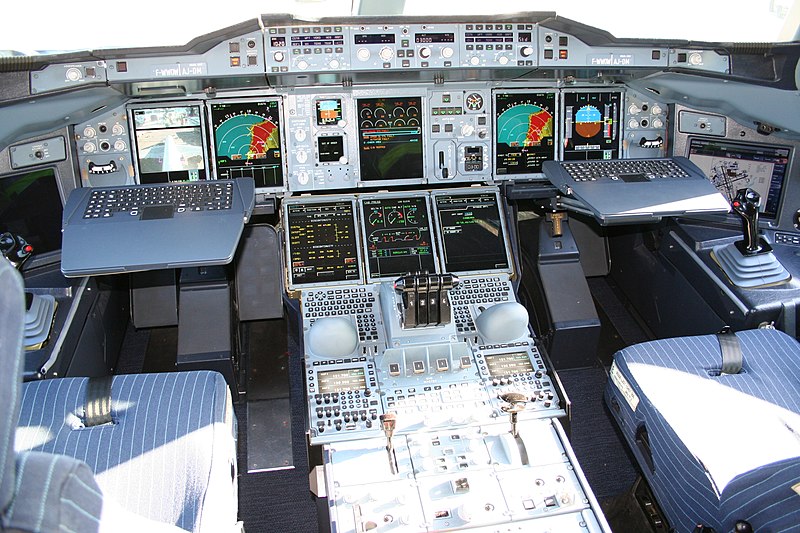

The flight deck
Airbus used similar cockpit layout, procedures and handling characteristics to those of other Airbus aircraft, to reduce crew training costs. Accordingly, the A380 features an improved glass cockpit, and fly-by-wire flight controls linked to side-sticks.The improved cockpit displays feature eight 15-by-20 cm (6-by-8-inch) liquid crystal displays, all of which are physically identical and interchangeable. These comprise two Primary Flight Displays, two navigation displays, one engine parameter display, one system display and two Multi-Function Displays. These MFDs are new with the A380, and provide an easy-to-use interface to the flight management system—replacing three multifunction control and display units. They include QWERTY keyboards and trackballs, interfacing with a graphical "point-and-click" display navigation system.One or two HUD (Head Up Display) is optional.
Engines
A Rolls-Royce Trent 900 engine on the wing of an Airbus A380

The A380 can be fitted with two types of engines: A380-841, A380-842 and A380-843F with Rolls-Royce Trent 900, and the A380-861 and A380-863F with Engine Alliance GP7000 turbofans. The Trent 900 is a derivative of the Trent 800, and the GP7000 has roots from the GE90 and PW4000. The Trent 900 core is a scaled version of the Trent 500, but incorporates the swept fan technology of the stillborn Trent 8104.The GP7200 has a GE90-derived core and PW4090-derived fan and low-pressure turbo-machinery. Only two of the four engines are fitted with thrust reversers.
Noise reduction was an important requirement in the A380's design, and particularly affects engine design.Both engine types allow the aircraft to achieve QC/2 departure and QC/0.5 arrival noise limits under the Quota Count system set by London Heathrow Airport, which is expected to become a key destination for the A380.
The A380 can run on mixed synthetic jet fuel with a natural-gas-derived component. A three hour test flight on Friday, February 1, 2008 between the Airbus company facility at Filton in the UK to the main Airbus factory in Toulouse, France, was a success. One of the A380's four engines used a mix of 60 percent standard jet kerosene and 40 percent gas to liquids (GTL) fuel. The aircraft needed no modification to use the GTL fuel, which was designed to be mixed with regular jet fuel. Sebastien Remy, head of Airbus SAS's alternative fuel program, said the GTL used was no cleaner in CO2 terms than regular fuel but it had local air quality benefits because it contains no sulphur.
While most of the fuselage is aluminium, composite materials make up 25% of the A380's airframe, by weight. Carbon-fibre reinforced plastic, glass-fibre reinforced plastic and quartz-fibre reinforced plastic are used extensively in wings, fuselage sections (such as the undercarriage and rear end of fuselage), tail surfaces, and doors. The A380 is the first commercial airliner with a central wing box made of carbon fibre reinforced plastic, and it is the first to have a wing cross-section that is smoothly contoured. Other commercial airliners have wings that are partitioned span-wise in sections. The flowing, continuous cross-section allows for maximum aerodynamic efficiency. Thermoplastics are used in the leading edges of the slats. The new material GLARE (GLAss-REinforced fibre metal laminate) is used in the upper fuselage and on the stabilizers' leading edges. This aluminium-glass-fibre laminate is lighter and has better corrosion and impact resistance than conventional aluminium alloys used in aviation. Unlike earlier composite materials, it can be repaired using conventional aluminium repair techniques.Newer weldable aluminium alloys are also used. This enables the widespread use of laser beam welding manufacturing techniques — eliminating rows of rivets and resulting in a lighter, stronger structure.
Compared to a 747, the A380 has larger windows and overhead bins, and 60 cm (2 ft) of extra headroom. The wider cabin allows for up to 48 cm (19 inch) wide economy seats at a 10 abreast configuration on the main deck,while 10 abreast seating on the 747 has a seat width of only 43.7 cm (17.2 inch) (seat pitch varies by airline).
Airbus' initial publicity stressed the comfort and space of the A380's cabin, anticipating installations such as relaxation areas, bars, duty-free shops, and beauty salons. Virgin Atlantic Airways already offers a bar as part of its "Upper Class" service on its A340 and 747 aircraft, and has announced plans to include casinos, double beds, and gymnasiums on its A380s.Singapore Airlines offers twelve fully-enclosed first-class suites on its A380, each with one full and one secondary seat, full-sized bed, desk, personal storage. Four of these suites are in the form of two "double" suites featuring a double bed. Qantas Airways has shown their product which features a long flat-bed that converts from the seat but does not have privacy doors. Emirates Airline's fourteen first-class private suites have shared access to two "shower spas". First and business class passengers have shared access to a snack bar and lounge with two sofas, in addition to a first-class-only private lounge.
Integration in the infrastructure
The A380's 20-wheel main landing gear

Early critics claimed that the A380 would damage taxiways and other airport surfaces. However, the pressure exerted by its wheels is lower than that of a Boeing 747 or Boeing 777 because the A380 has 22 wheels, four more than the 747, and eight more than the 777. Airbus measured pavement loads using a 540-tonne (595 short tons) ballasted test rig, designed to replicate the landing gear of the A380. The rig was towed over a section of pavement at Airbus' facilities that had been instrumented with embedded load sensors.
Based on its wingspan, the U.S. FAA classifies the A380 as a Design Group VI aircraft, and originally required a width of 60 m (200 ft) for runways and 30 m (100 ft) for taxiways, compared with 45 m (150 ft) and 23 m (75 ft) for Design Group V aircraft such as the Boeing 747. The FAA also considered limiting the taxi speed of the A380 to 25 km/h (15 mph) when operating on Group V infrastructure, but issued waivers related to the speed restriction and some of the proposed runway widening requirements.Airbus claimed from the beginning that the A380 could safely operate on Group V runways and taxiways, without the need for widening. In July 2007, the FAA and EASA agreed to let the A380 operate on 45 m runways without restrictions.

The A380 was designed to fit within an 80 × 80 m airport gate, and can land or take off on any runway that can accommodate a Boeing 747. Its large wingspan can require some taxiway and apron reconfigurations, to maintain safe separation margins when two of the aircraft pass each other. Taxiway shoulders may be required to be paved to reduce the likelihood of foreign object damage caused to (or by) the outboard engines, which overhang more than 25 m (80 ft) from the centre line of the aircraft. Any taxiway or runway bridge must be capable of supporting the A380's maximum weight. The terminal gate must be sized such that the A380's wings do not block adjacent gates, and may also provide multiple jetway bridges for simultaneous boarding on both decks. Service vehicles with lifts capable of reaching the upper deck should be obtained, as well as tractors capable of handling the A380's maximum ramp weight.The A380 test aircraft have participated in a campaign of airport compatibility testing to verify the modifications already made at several large airports, visiting a number of airports around the world.
Takeoff and landing separation
In 2005, the ICAO recommended that provisional separation criteria for the A380 on takeoff and landing be substantially greater than for the 747 because preliminary flight test data suggested a stronger wake turbulence. These criteria were in effect while the ICAO's wake vortex steering group, with representatives from the JAA, Eurocontrol, the FAA, and Airbus, refined its 3-year study of the issue with additional flight testing. In September 2006, the working group presented its first conclusions to the ICAO, which rendered new interim recommendations on the issue in November 2006.
The ICAO advised that an aircraft trailing an A380 during approach should maintain a separation of 6 nmi, 8 nmi and 10 nmi respectively for non-A380 "Heavy", "Medium", and "Light" ICAO aircraft categories, compared with 4 nmi, 5 nmi and 6 nmi spacing for other "Heavy" aircraft. Another A380 following an A380 should maintain a separation of 4 nmi. On departure behind an A380, non-A380 "Heavy" aircraft are required to wait two minutes, and "Medium"/"Light" aircraft three minutes for time based operations. The ICAO also advised to use the suffix "Super" to the air traffic control to distinguish the A380 from other "Heavy" aircraft.
Airbus continued undertaking extensive comparative trials until December 2007 and expects the ICAO's wake vortex steering group to issue revised distances similar to those required by the Boeing 747.

Economy class fuselage-comparison between Airbus A380 and the front-section of Boeing 747, the next-largest passenger aircraft
| A380-800 | A380-800F | |
| Cockpit crew | Two | |
| Seating capacity | 525 (3-class) | 12 couriers |
| Length | 73 m (239 ft 6 in) | |
| Span | 79.8 m (261 ft 10 in) | |
| Height | 24.1 m (79 ft 1 in) | |
| Wheelbase | 30.4 m (99 ft 8 in) | |
| Outside fuselage width | 7.14 m (23 ft 6 in) | |
| Cabin width, main deck | 6.58 m (21 ft 7 in) | |
| Cabin width, upper deck | 5.92 m (19 ft 5 in) | |
| Wing area | 845 m² (9,100 sq ft) | |
| Operating empty weight | 276,800 kg (610,200 lb) | 252,200 kg (556,000 lb) |
| Maximum take-off weight | 560,000 kg | 590,000 kg (1,300,000 lb) |
| Maximum payload | 90,800 kg | 152,400 kg (336,000 lb) |
| Cruising speed | Mach 0.85 | |
| Maximum cruising speed | Mach 0.89 | |
| Maximum speed | Mach 0.96 | |
| Take off run at MTOW | 2,750 m (9,020 ft) | 2,900 m (9,510 ft) |
| Range at design load | 15,200 km (8,200 nmi) | 10,400 km (5,600 nmi) |
| Service ceiling | 13,115 m (43,000 ft) | |
| Maximum fuel capacity | 310,000 L (81,890 US gal) | 310,000 L (81,890 US gal), |
| Engines (4 x) | GP7270 (A380-861) | GP7277 (A380-863F) |
| Thrust (4 x) | 311 kN (70,000 lbf) | |
CONCULSION:
Airbus top sales executive and COO John Leahy confirmed the plans for an enlarged variant, the A380-900 which is a slight stretch of the A380-800 from 73m to 79.4m in length. This version would have a seat capacity of 650 passengers in standard configuration, and around 900 passengers in economy-only configuration. The development of the A380-900 is planned to start once production of the A380-800 variant reaches 40 planes per year, expected to be in 2010. Given this timeline, the first A380-900s could be delivered to customers around 2015 at about the same time as the freighter variant A380-800F. Airlines including Emirates,Virgin Atlantic, Cathay Pacific and Air France, as well as leasing company ILFC have already expressed interest in the extended model.According to an interview in Airliner World magazine's December issue, Singapore Airlines CEO Chew Choon Seng revealed at the delivery of their first A380-800 that the airline is keeping their options open with their order, by only defining their first ten A380s as -800s; the remaining nine aircraft could be switched to -900s.


 tional losses, the power absorbed by the propeller can also be expressed by


